Looking back at Web Summit 2025 (can't wait for this year's summit!), one thing in particullary has stayed with me.
It wasn’t the technology itself. We’ve all seen robots before, at least I hope. What surprised me was the level of reality, or shall I say maturity, it already achieved.
The conversation had shifted.
From innovation. To operational necessity.
I remember sitting in that session thinking: this isn’t about futuristic robots anymore. This is about who will actually unload warehouses in five years — and who hopefully won’t have to, because the heaviest physical strain might finally be taken over by machines that protect workers’ health instead of replacing them. At least I hope so.
That shift matters.
The presentation by Boston Dynamics brought three dimensions into one coherent picture: demographics, AI, and industrial execution. None of these topics is new. But seeing them as a connected unit — not as trends, but as a system — made the argument harder to ignore.
What follows is my interpretation, and yes, a deliberately critical one — especially through a European lens.
The demographic charts shown on stage were not groundbreaking. We know the story: declining populations, ageing societies, shrinking workforces.
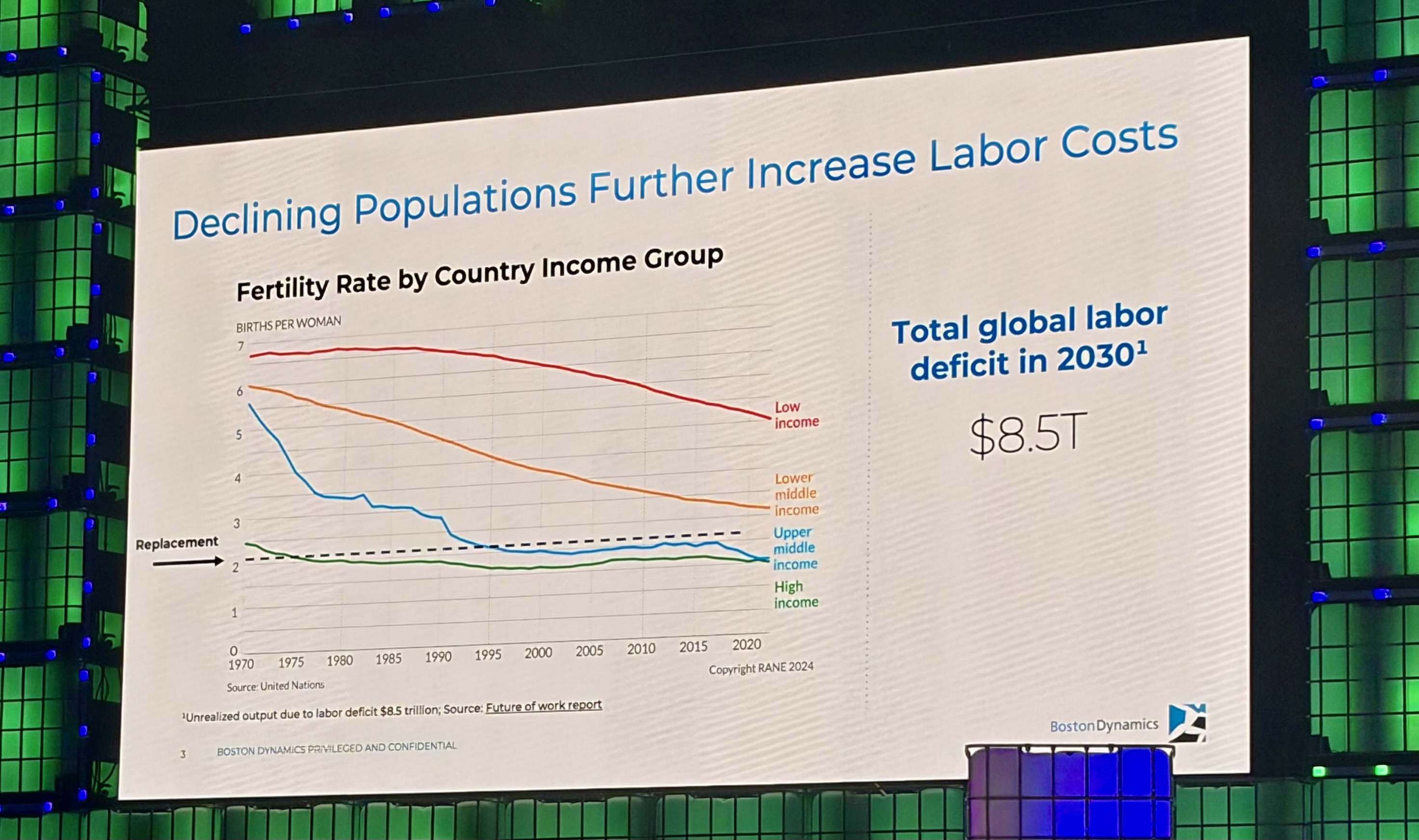
But sometimes it’s important to look again.
Because the implication is different when it moves from policy debate into factory planning.
We are facing rising labour costs and, more importantly, labour gaps. Not theoretical ones. Real ones. The session referenced projections of a global labour deficit measured in trillions of dollars by 2030.
From a transformation perspective, this reframing is significant.
When automation shifts from being an efficiency lever to becoming continuity infrastructure, board-level conversations change.
Robotics is no longer about margin optimisation.
It is about operational resilience if done correctly.
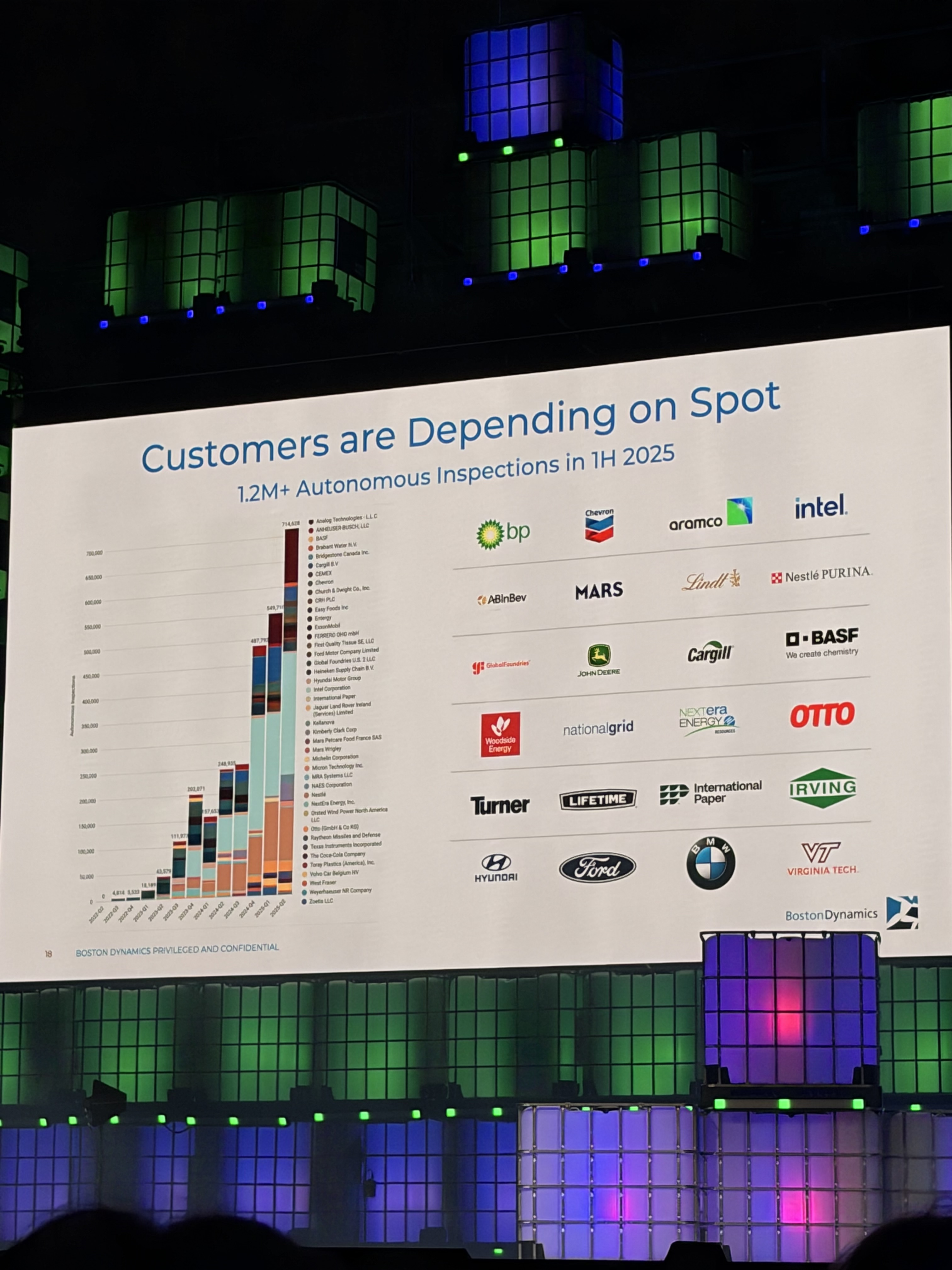
Concrete signals from the session reinforced that shift:
This is not experimentation.
It is operational reliance.
And here is the uncomfortable question: are these jobs automated purely to increase efficiency — or because companies simply cannot find enough people willing or able to do them? In logistics and heavy manufacturing, the answer increasingly seems to be the latter.
Robots alone are not new.
What changes the equation is the combination of robotics and generative AI.
The moment that stood out to me most was the “Natural Language Inspection” example.
Instead of specialised interfaces and trained operators, teams can now ask:
“Show me anomalies from the last inspection.”
“Where did temperature exceed limits?”
That is a profound shift.
It lowers the expertise threshold and expands who can interact with these systems.
Then there is scale.
Stretch has moved over 18 million boxes for companies like DHL, Inditex, GAP and Lidl. That number is not symbolic. It is operational proof.
Atlas, positioned for manufacturing environments, targets physically demanding and ergonomically harmful tasks. This is where the conversation becomes more nuanced.
Robots are not general-purpose replacements. They are economically viable where tasks are repetitive, physically exhausting, or unsafe.
And if they can prevent long-term musculoskeletal damage in workers — that is not a dystopian story. That is overdue.
One full section of the session focused on human–robot safety: pause-on-approach, two-meter safety zones, defined collaboration spaces.
This was not marketing language. It was detailed engineering.
For Europe, this matters. Social acceptance of robotics will not depend on speed of deployment. It will depend on whether workers feel protected rather than displaced.
Technology adoption without trust will stall.
Boston Dynamics framed sustainable robotics adoption around four pillars:
“Customer value” here clearly means corporate value: ROI, service integration, reliability in operations.
What struck me was that technology was not presented as the headline. Integration and economic realism were.
That’s an important shift. Vision without deployability is irrelevant.
The idea that stayed with me most is this:
Robotics is increasingly functioning as a labour-market stabiliser.
Not a dramatic “shock absorber,” but something more structural. It absorbs strain where labour shortages would otherwise break systems — in infrastructure, logistics, manufacturing.
It fills gaps, prevents bottlenecks and buys time.
And buying time may be the most valuable function of all.
Europe, however, is not one labour market. Participation rates differ and so do Demographic pressure and Productivity levels.
So let’s be clear: robotics will help Europe. But there is abig BUT: it will not fix Europe’s structural challenges.
Demographics are only part of the story. Skills mismatches, rigid labour systems and uneven digital maturity remain significant constraints.
Large enterprises can deploy fleets of robots. Many SMEs cannot — unless financing models evolve dramatically.
And Europe’s regulatory strength, while protective, can slow deployment if not paired with serious re-skilling initiatives.
Robotics buys time.
It does not replace education reform, migration strategy, or lifelong learning.
If Europe wants to turn this into a competitive advantage rather than a defensive adaptation, three moves are critical:
Because the alternative is stagnation.
The future of work is not human or robot.
It is human with robot with a strong ethical consideration.